When I began writing The Long Grass, I knew very early that I didn’t want to set the story in Sydney, Melbourne or even my home city of Brisbane. I wanted to return to a place that had made an enormous impression on me as a young man.
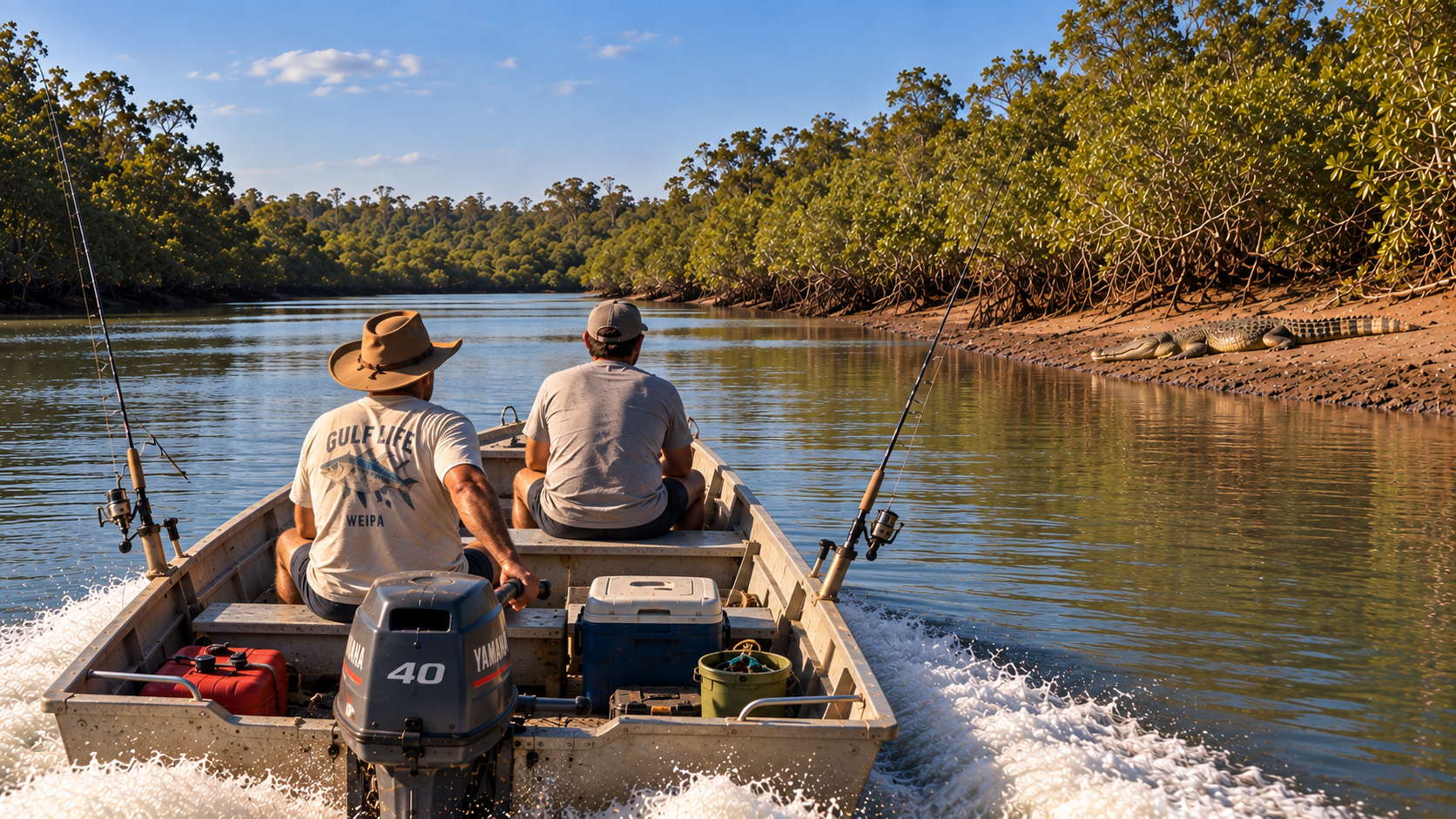
I spent time in Weipa in 1985, the same year in which the novel is set, and it was unlike anywhere else in Australia I had experienced. The isolation, the red dirt, the sometimes confronting social attitudes and the casual acceptance of things that seemed extraordinary to a young bloke from Brisbane all stayed with me. So did the landscape and wildlife — fishing remote estuaries from small aluminium dinghies, sharing the waterways with crocodiles and catching what sometimes seemed like more sharks than fish. Weipa was beautiful, rough around the edges and, at times, unforgiving. Nearly forty years later, when I began looking for a setting for The Long Grass, it was a place I could still see remarkably clearly.

Weipa was somewhere where three murders would feel both shocking and strangely possible.
For readers outside Australia, and probably quite a few Australians as well, Weipa isn’t a place they’re likely to know much about. It’s a remote mining town on the western side of Cape York Peninsula in Far North Queensland, looking out across the Gulf of Carpentaria.
And in 1985, when The Long Grass is set, it was considerably more isolated than it is today.
That isolation was one of the things that attracted me to it as a setting for a crime novel.
The Long Grass begins with three men sleeping rough near Stubby Beach, not far from the local hotel. By morning, all three are dead.
One has had his throat cut. Another has been killed with a rock. The third has been shot.
Detective Sergeant Annette Mollison and Detective Senior Sergeant Dave O’Reilly are sent north to investigate, and from the beginning they’re working in a very different environment from the one they’re accustomed to.
That’s important to the story.
I didn’t want Weipa simply to be a name printed underneath the words ‘Chapter One’. I wanted the place itself to influence what happened.
The heat, the red dirt, the Gulf, the mining industry and the sheer distances involved all helped shape the story. So did the social attitudes of Queensland in the mid-1980s.
Setting the novel in 1985 also meant removing many of the conveniences a modern detective takes for granted. There are no mobile phones, no internet searches, no instant DNA matches and no databases that can be accessed from a laptop in the back of a police vehicle.
Information takes time to arrive. People have to be found and spoken to. Evidence has to travel enormous distances. Sometimes a detective simply has to get on an aircraft and go somewhere.
For a crime writer, that’s rather useful.
But Weipa offered something else as well.
It gave me the opportunity to place Annette Mollison somewhere she couldn’t simply blend into the background.
Annette is a female detective working in Queensland in 1985. She’s intelligent, capable and determined, but she’s operating in a police force and a society where attitudes towards women were very different from today.
Put her in a remote Far North Queensland mining town and those differences become even harder to ignore.
That tension became an important part of the novel.
So did the landscape.
There’s something about Far North Queensland that lends itself extraordinarily well to crime fiction. It’s beautiful, but it can also be unforgiving. Enormous distances separate communities. The bush can hide things. The weather dictates what people can and can’t do. And once you move away from the populated coastal strip, there are places where disappearing isn’t particularly difficult.
For a murder mystery, that’s fertile ground.
Researching Weipa and Far North Queensland in the mid-1980s eventually became one of my favourite parts of writing The Long Grass. I spent a great deal of time trying to understand not just what the town looked like, but how people lived, travelled, worked and communicated.
Some of those details became important to the plot. Others amounted to a sentence or two. Plenty never made it into the book at all.
But collectively they helped create the world in which Annette Mollison’s investigation takes place.
And that was ultimately why I chose Weipa.
I didn’t just need somewhere for three murders to happen.
I needed somewhere that would become part of the story.
Leave a Reply