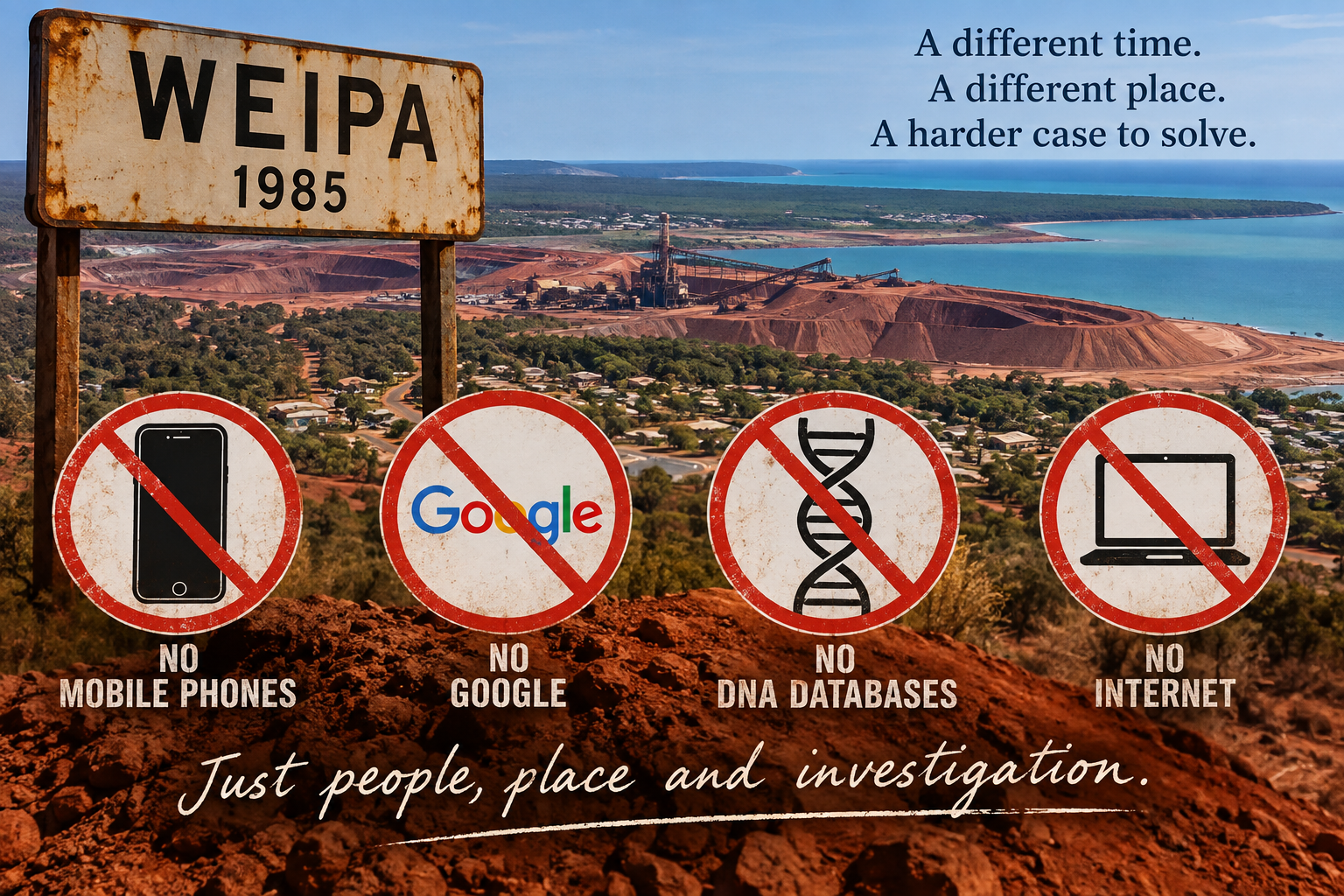

If Annette Mollison had owned a mobile phone, The Long Grass would probably have been a much shorter book.
There were a number of things that attracted me to setting the novel in Weipa in 1985. The first, obviously, was Weipa itself.
I spent time there that year, working at the local pub, and witnessed a number of things that have stayed with me ever since. Some were funny. Some were extraordinary. A few were genuinely frightening. Weipa in 1985 was a remote mining town with its own characters, its own rules and, at times, its own definition of what constituted normal behaviour.
Nearly forty years later, when I began writing The Long Grass, I realised I had never really forgotten the place.
Then there were the people.
Working in the pub meant I met people from just about every part of the community. Miners, fishermen, truck drivers, locals, drifters and people who seemed to have arrived in Weipa without any particular intention of ever leaving.
I also got to know some of the local police.
They were policing an enormous and isolated part of Far North Queensland with nothing resembling the technology available to police today. I remember being impressed by their characters and by the way they dealt with the peculiarities of the place. Some of that inevitably found its way into Sergeant Mike Carter, the Weipa copper who appears in The Long Grass.
But there was another reason 1985 appealed to me as a crime writer.
Technology — or rather, the lack of it.
Think about what happens when a murder is committed today.
Within minutes, people can be contacted by mobile phone. Photographs can be transmitted instantly. Police can search computer databases from almost anywhere. CCTV may have recorded someone’s movements. Mobile phone records can establish where people have been. DNA profiles can be compared electronically. A name, address or vehicle registration can potentially lead to an enormous amount of information within seconds.
Annette Mollison and Dave O’Reilly had none of that.
When three murdered men are discovered in the long grass near Stubby Beach in The Long Grass, the detectives arrive in a town thousands of kilometres from Brisbane with no mobile phones, no Google, no internet and no DNA database waiting to provide an answer.
Information has to be found.
People have to be located and spoken to. Records have to be requested. Telephone calls require an actual telephone. Evidence collected in Weipa may need to travel to Cairns or Brisbane before anybody can properly examine it. Sometimes, if you need information from somewhere else, you simply have to wait for somebody to get it to you.
And distance matters.
Weipa in 1985 was genuinely remote. That means a detective couldn’t necessarily make a phone call and have a specialist standing beside them an hour later. Geography became part of the investigation.
For me, that made solving a murder both more difficult and, from a storytelling point of view, considerably more interesting.
Modern technology is wonderful, but it can be terribly inconvenient for a crime writer.
Put a mobile phone into a character’s pocket and suddenly you have to explain why they don’t simply ring somebody. Give your detectives access to Google and enormous electronic databases and questions that might once have taken several chapters to answer can potentially be resolved in minutes.
Take all of that away and something interesting happens.
The detectives have to detect.
They have to notice things. They have to talk to people. They have to remember what somebody said three days earlier and realise that it doesn’t quite fit with something they’ve just discovered. They have to follow leads that might go nowhere. And sometimes they have to sit around waiting for information to arrive.
That slower process suited the story I wanted to tell.
It also suited Annette Mollison.
Annette isn’t a detective because she has better technology than everybody else. She’s a detective because she’s observant, intelligent, persistent and very difficult to bullshit.
So when I look back at the decision to set The Long Grass in Weipa in 1985, I don’t think it was any one thing that made the setting work.
It was the combination.
The place. The time. The isolation. The characters I remembered from being there. And a style of policing that depended far more heavily on people than technology.
Of course, there was one other advantage.
Nobody could pull out a mobile phone and Google who the murderer was.
Leave a Reply